

Founders and physicists may work in different orbits, but they share a gravitational pull toward hard problems. Both work at the edge of what’s known. They rally people around uncertain ideas and know breakthroughs rarely happen without a few things breaking first.
This common ground drew founders, tech leaders, physicists and researchers to Wednesday night’s Founders & Physicists, hosted by Nabil G. Fahel, Vice President at Communitech, at the Tannery Event Centre in Downtown Kitchener.
The event featured Dr. Avery Broderick, Professor at the University of Waterloo and Research Associate Faculty at Perimeter Institute, and Rahul Goel, founder and CEO of NordSpace, who’s chasing what he calls Canada’s “Apollo moment.” Goel was originally scheduled to join February’s Founders & Physicists conversation about Canada’s reach for orbit, but a grounded flight in Mexico kept him offstage.
First up, speed up science
Before black holes and blastoffs, Waterloo Region entrepreneur Ali Asaria brought AI into the equation. The University of Waterloo computer engineering grad created BrickBreaker (a name that may trigger some muscle memory for longtime BlackBerry users) before founding Well.ca and Tulip. He’s now co-founder and CEO of Transformer Lab, which is using AI to speed up scientific research.
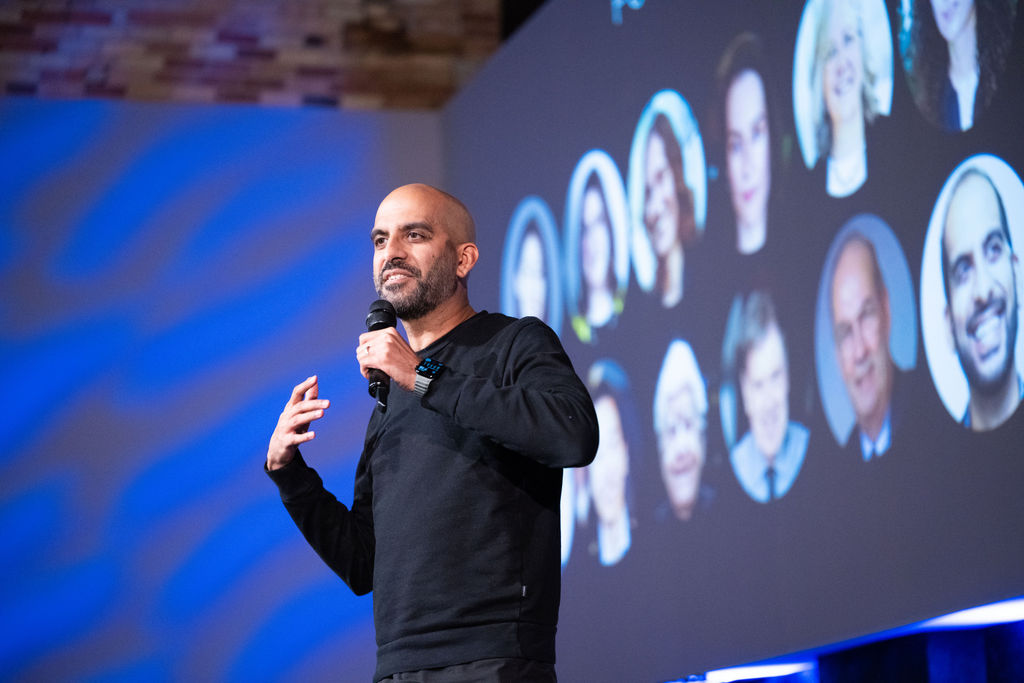
Its newest project, Primus, runs much of the research loop itself, from forming hypotheses and reviewing literature to coding, running experiments and producing a finished paper. Asaria said scientific progress has historically operated “at a human speed,” but with AI, parts of that process can now happen in “days or hours.” He asked researchers in the room to try Primus because Ali thinks it will allow any researcher in a university or private lab to do research 30X faster than ever before, possibly allowing all of humanity to discover scientific truths faster than ever before.
How do you photograph the unphotographable?
From speeding up research to stretching the limits of observation, the evening moved from AI to astrophysics. Broderick is a founding member of the Event Horizon Telescope (EHT) collaboration, which produced the first-ever image of a black hole in 2019.
M87* sits about 55 million light-years away and has a mass roughly 6.5 billion times that of the sun. EHT made it visible by linking radio telescopes around the planet to effectively create an Earth-sized virtual telescope. The result became one of the most recognizable scientific images of the century, what Broderick jokingly referred to as a “big fuzzy fiery donut.”

The first image of a black hole, M87*, released in 2019. Source: EHT Collaboration.
For Broderick, the breakthrough was as much about approaching the problem differently as it was about scale. Sometimes doing more of what already works is the right answer, he said, “but often different wins.”
The technology was only part of the challenge. EHT also had to build a community capable of carrying the work forward.
“If you cannot grow your next group of leaders, then you’re really a short-lived endeavour,” said Broderick.
He said many of the younger researchers who took a career risk on EHT are now leading it.
"Not only do they have a seat at the table, quite often they’re chairing the discussion.”
Praise for “high-quality” failures
Ambitious work also means creating room to get things wrong. While EHT researchers were working 16-hour days, Broderick said the team discovered around 2 a.m. that something had gone wrong with the images they were generating.
“But you fix the problem, not the blame,” said Broderick. “If you’re never failing, you’re not ambitious enough.”
Rocket science raises the stakes, and occasionally, the burn rate. NordSpace has had its share of setbacks, including multiple launchpad fires during a 2025 launch window.
“There’s nothing like seeing a quarter of a million dollars disappear in seconds. You just have to brush it off and keep going,” said Goel. “The important thing for us is making sure our failures are high quality. We’re going to get to orbit. We’re going to have some bumps along the way. That’s part of the journey.”
Canada’s unfinished business in space
Goel’s fascination with space started early.
“I just never grew up,” he said.
As a kid, he wanted to be an astronaut. He later studied astrophysics and engineering, built technology companies and founded NordSpace in 2022.
Canada has its own history of aerospace ambition. It developed the supersonic Avro Arrow in the 1950s before the program was cancelled in 1959. Three years later, Alouette 1 made Canada the third country to design and build its own satellite, although it reached space aboard an American rocket. More than six decades later, Canada remains the only G7 country without sovereign space-launch capability.
“When we started NordSpace, we would talk about a sovereign launch and people would think we were some crazy patriots waving the Canadian flag. Now everyone loves it,” said Goel. “I want to see a program like ours feel like a national victory.”
Waterloo Region’s gravitational pull
Waterloo Region has been a launchpad for big ideas for decades.
At Perimeter Institute, Broderick recalled being told during his interview that it wasn’t about “how many papers you publish in your career, it’s about the one paper that justifies your career.” That was a sharp contrast to the “publish or perish” culture common in academia. The message was to give researchers room to pursue bigger questions, even when the payoff was uncertain.
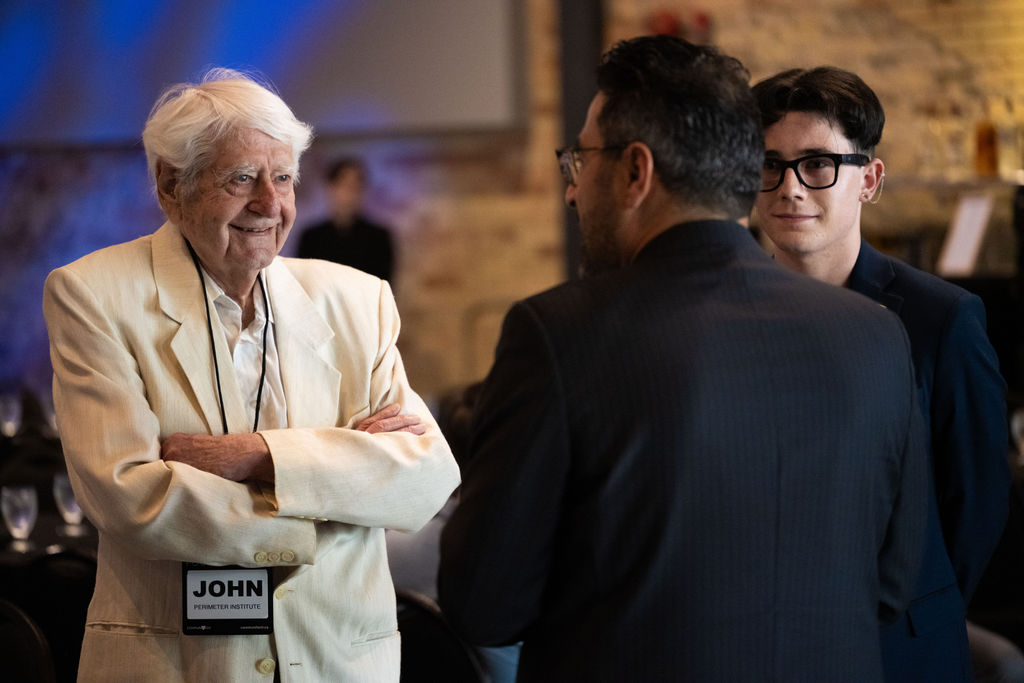
He found a similar philosophy at the University of Waterloo, where its creator-owned intellectual property (IP) policy generally lets researchers own what they create.
“That was amazing to me because that’s not how it is anywhere else,” Broderick said.
Goel brought the conversation back to the people willing to take on those ambitious ideas. Building something as difficult as a Canadian rocket, he said, takes people with a strong enough “why” to keep going when the work gets hard.
“The greater risk is not taking the next step and not building upon what you started.”
###