

Health care’s ‘Netflix moment’ needs Founders & Physicians at the same table
Nearly six million Canadians don’t have a family doctor.
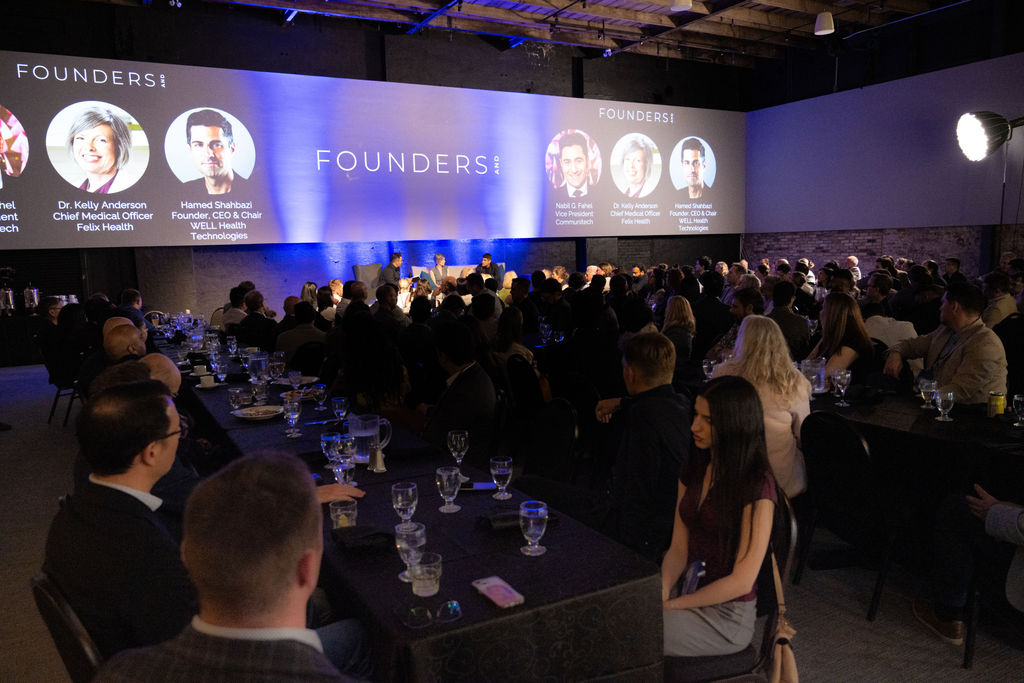
That number was less a statistic than a starting point at Founders & Physicians, presented by Communitech, and hosted by Communitech’s Nabil G. Fahel.
Fahel was joined on stage by Dr. Kelly Anderson, Chief Medical Officer at Felix Health, and Hamed Shahbazi, Founder, Chairman and CEO of WELL Health Technologies, for a conversation about what comes next for primary care and how to keep care human while the tools change. More than 170 guests filled the room, including tech founders, physicians, academic leaders and policymakers.
.jpg)
The front door is jammed
Anderson spent much of her career in family medicine, including 15 years at the Inner City Family Health Team at St. Michael’s Hospital in Toronto. At Felix, a Canadian telemedicine platform, she now helps guide virtual care for common conditions through online visits and secure messaging.
Anderson says she saw the pressure in the room at the first Founders & Physicians event in January.
“Every family doctor I talked to in the room had either left family medicine or was planning to leave family medicine,” she said.
At Felix, that pressure is showing up in patient demand.
“This year we’re seeing 100 per cent year-over-year growth in terms of the number of visits to the health care platform compared to last year,” she said.
Access, not convenience, was the point. Patients wait too long. Information doesn’t always move cleanly. In-person care is still treated as the gold standard. And somehow, fax machines are still around.
“We’ve been in the ‘Blockbuster’ phase of medicine and we need Netflix,” she said. “Between Blockbuster and Netflix there was a period of time when Netflix was mailing DVDs. We’re in the mailing DVDs phase, and it’s events like this where we can think ourselves forward into a transformed offering.”
Anyone who’s lived through a platform transition knows that awkward middle. The old model still works, until it doesn’t. The new model is visible, but not fully built. Health care is working through that gap now, with higher stakes than streaming ever had.
‘No one is coming to save us’
Anderson remembers watching fewer medical students choose family medicine and hoping, at some point, the system would change.
“I was like ‘no one is coming to save us,’” she said. “We need to figure out the ways to get health care for ourselves.”
She said medical training teaches physicians to be deeply rigorous and risk-aware, which is critical for patient safety. But that same training can make it harder to step back and imagine care being delivered in a completely different way. Her ideal version of healthtech isn’t founders pulling doctors into the future, or doctors slowing founders down. It’s both sides learning how to think a little more like the other.
“When you get to the point in your company where the entrepreneurs at the table are the ones saying we need to do it this way because it’s patient first and we need to think about the patient and the doctor is saying I think we should build outside the box like Netflix, then you have succeeded,” she said.
Give physicians their time back
Shahbazi moved the conversation from the patient’s front door to the physician’s desktop. Before founding WELL, now Canada’s largest outpatient medical clinic network, he built TIO Networks into a fintech company acquired by PayPal for more than $300 million. He knows what it means to scale a company. Through WELL, he also sees what happens when technology meets the daily friction of clinic life.
“Doctors tend to work harder, they tend to have two jobs,” Shahbazi told the room. “One is providing care, the other is being the operator.”
That second job lives in the inbox. After a visit, the information keeps coming, such as lab results, prescriptions, referrals and patient history. One result can change the direction of care and one missed detail can create risk. Shahbazi’s point was that perfection is an impossible expectation inside a workflow that asks one person to absorb everything.
“How is it even possible for a doctor to do their job properly and have zero errors? It’s not an error. It’s humanly impossible,” Shahbazi said. “This is where I think AI has a real opportunity to be a companion to the physician.”
He described generative AI as a way to change the feel of the exam room, so doctors spend less time anchored to a screen and more time present with the patient in front of them. The payoff, Shahbazi said, is time.
“We’re delivering two hours a day back to the doctor,” he said. “Technology should free them up to be more human.”
Trust has to scale too
In health care, trust has to be built into the model from the beginning.
Anderson said Felix made an early decision that patient safety would guide the company. That meant building with the belief that doing right by the patient wasn’t in conflict with company growth.
Shahbazi made a similar point through the lens of leadership.
“I don’t think it matters if you’re public or private, it matters what you stand for,” he said. “It’s a question of leadership, culture and transparency.”
The delivery of primary care may still be somewhere between fax machines and streaming platforms. That’s where the opportunity sits. The next version of care will come from people close enough to understand the strain in the system and bold enough to build something better, without losing sight of what makes care human.
###