

By Nardine Nakhla, Founder & CEO, MAPflow
When I look back at how far MAPflow has come, I often think about one of the very first pharmacists who tried our platform.
In the first month after MAPflow launched, he thought the software was broken.
He told me, “I didn’t even want to deliver these services at first, as the learning curve seemed too steep, but my pharmacy manager got us MAPflow to help with the process, so I gave it a try.”
When he assessed one patient with symptoms that initially looked like a routine urinary tract infection, MAPflow’s clinical engine repeatedly flagged concerning features suggesting that medical escalation was necessary.
Rather than resolving the case in the pharmacy, MAPflow recommended referral to a physician. Trusting the system’s guidance, the pharmacist referred her to a doctor instead of prescribing antibiotics.
A week later, the patient returned to thank him. Further tests at the hospital revealed she had bladder cancer, caught in its earliest stage.
That moment showed me the real power of this platform. It’s not just about streamlining documentation or improving workflow. It’s about equipping pharmacists with evidence-based tools that enhance clinical judgment and optimize health outcomes. In some cases, like this one, it can contribute to life-saving care by prompting earlier medical attention when red flags appear.
When pharmacies become trusted access points for people without a regular doctor, those facing barriers to timely care, or anyone seeking accessible help for their health concerns, the impact can be profound, even life-changing.
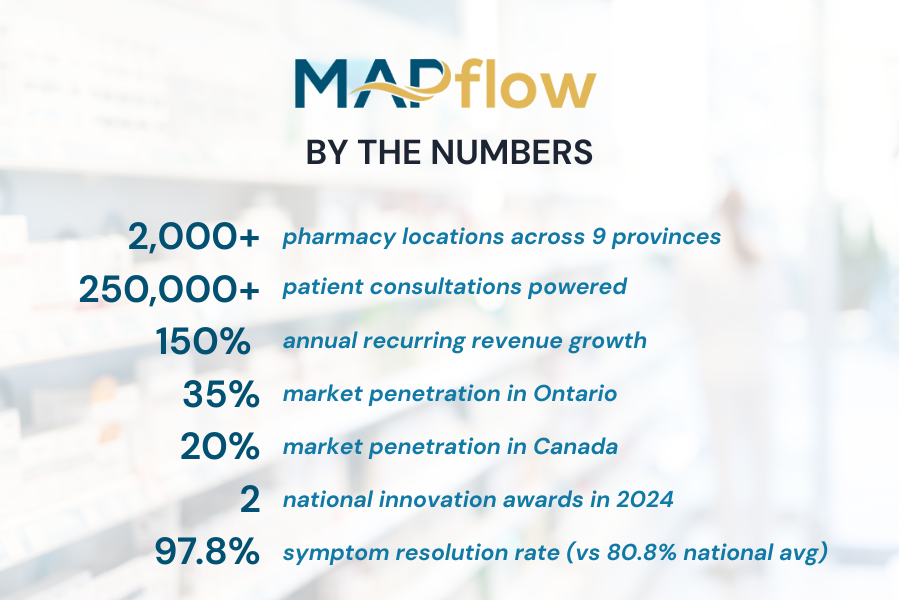
With a 97.8 per cent symptom resolution or significant improvement rate (well above the 80.8 per cent national average for similar pharmacy-based care), MAPflow demonstrates that well-designed digital tools for pharmacy care can improve clinical outcomes and save the health-care system tens of millions of dollars.
Just as EMRs transformed physician practices, MAPflow is becoming the operating system for pharmacy-led clinical services.
Ontario pharmacists are taking on more
Stories like this are unfolding as Ontario pharmacists take on expanded responsibilities. Since January 2023, they’ve been authorized to assess and treat 13 minor ailments, a list that grew by six more in October 2023. The province has also just announced plans to move forward with 14 more conditions, from mild headaches to shingles.
Since the program launched, pharmacists have provided over two million assessments with nearly 100 per cent of community pharmacies participating.
As a practising pharmacist and a member of the Ontario College of Pharmacists’ Minor Ailments Advisory Group, which drafted the regulations that made pharmacist prescribing possible, I saw firsthand how complex implementation would be without the right tools to support pharmacists clinically and operationally.

Built in Canada, for Canadian pharmacists
Pharmacists are among the most accessible health-care providers in Canada, with the knowledge and training to deliver high-quality primary care. Yet outdated workflows, fragmented systems, and regulatory complexity often keep them from practicing at their full potential. It’s like training race-car drivers but handing them bicycles. MAPflow was built to close that gap.
MAPflow was conceived by myself, Dr. Andrea Edginton, and Michael Sevestre to support pharmacists amid Ontario’s expanding scope. The platform embeds clinical decision support and automated documentation tailored to each condition, ensuring care that is safe, effective, compliant, and efficient, while adapting continuously to the latest evidence.
Its structured algorithms and adaptive clinical intelligence help pharmacists deliver real-time, personalized care plans within their legal and professional scope.
Scaling a new model of care
More than 2,000 pharmacy locations are now using MAPflow across nine provinces, powering over 250,000 patient consultations and growing every month.
Each of those interactions represents timely care that might otherwise have been delayed or missed. That’s the real measure of our success. It shows the collective power of pharmacists to expand access to care and reduce pressure on an overstretched health system. MAPflow is scaling a new model of primary care that bridges policy and practice nationwide.
MAPflow also helps pharmacists stay compliant with provincial regulations and save time. In Ontario, pharmacists are legally required to follow up with patients and track outcomes after prescribing. MAPflow automates much of this process, which pharmacists tell us feels like it’s saving them a full-time staff member. It allows them to deliver clinical care efficiently while staying compliant.
MAPflow not only improves clinical results, but also generates the real-world data that regulators, funders, and health leaders need to feel confident in scaling pharmacy care.
Economic research shows that pharmacist-led minor ailment prescribing saves $40-$60 per patient compared to physician visits. With MAPflow already facilitating more than 250,000 patient interactions, conservative estimates suggest annual healthcare system savings in the tens of millions.
Why MAPflow is building in Waterloo Region
I’ve called Waterloo Region home for nearly two decades, as I began my academic pharmacy career here in 2009.
This Waterloo community has a rare mix of world-class research, health-care depth, and startup grit. The Accelerator Centre and Communitech programs helped guide us from startup to scale-up. When we entered AC:Studio in 2022—an innovative, three-phase entrepreneurial support program—we gained the tools and services we needed to grow and thrive. They even facilitated meetings with federal ministers and provincial MPPs, giving us direct access to policymakers who understand the urgency of health innovation. It’s a place where we can test ideas with real practitioners and scale them with technical talent.
Three years later, we joined the AC’s Rev:Lab program to turn early traction into scalable revenue. That journey, from initial validation to national scale, proves that Waterloo’s innovation ecosystem doesn’t just launch companies, it grows them. It’s a community that backs bold ideas with real-world testing, technical talent, and direct access to decision-makers who believe in the future of health care.
MAPflow also benefits from the involvement of local pharmacy students, whose feedback helps shape product updates and continuous innovation.
What’s next
Our immediate focus is on preparing for the next wave of pharmacy evolution. We’ve reached an incredible milestone: pharmacists in all 10 provinces and Yukon can now assess and prescribe for common conditions. But this is only the starting line.
The natural next step is moving beyond these minor ailments into broader prescribing authority, chronic disease management, deeper collaboration with primary care teams, and extending virtual care into underserved communities.
We’re proud to say MAPflow is built in Canada, by Canadians, for the Canadian health system. But we’re already seeing interest beyond our borders. Inquiries from the U.S., the U.K., and other regions confirm this model resonates internationally.
Still, scaling MAPflow requires discipline. Health-care software can’t have bugs or downtime. Every line of code we write affects real patient outcomes. That’s a higher standard than most tech companies face, but it’s one we’re committed to meeting.
My long-term vision is to accelerate a new, data-driven model of pharmacist-led care that improves access, outcomes, and policy feedback loops in real-time.
The next decade will separate pharmacists who adapt from those who don’t. MAPflow is the difference between thriving in an expanded scope and being overwhelmed by it. The future of primary care is local, pharmacist-led, and tech-enabled, and MAPflow is helping build it, one consultation at a time.
About the Author
Nardine is a leading Canadian pharmacist, educator and entrepreneur specializing in minor ailment management, non-prescription therapeutics and pharmacy innovation. She is also an Associate Professor at the University of Waterloo School of Pharmacy and a practising community pharmacist. Her leadership has been recognized nationally, including the 2024 Pharmacy Practice and Business Innovation Award, the 2025 Practice Excellence in Minor Ailments Services Award, and the Pfizer Bowl of Hygeia.